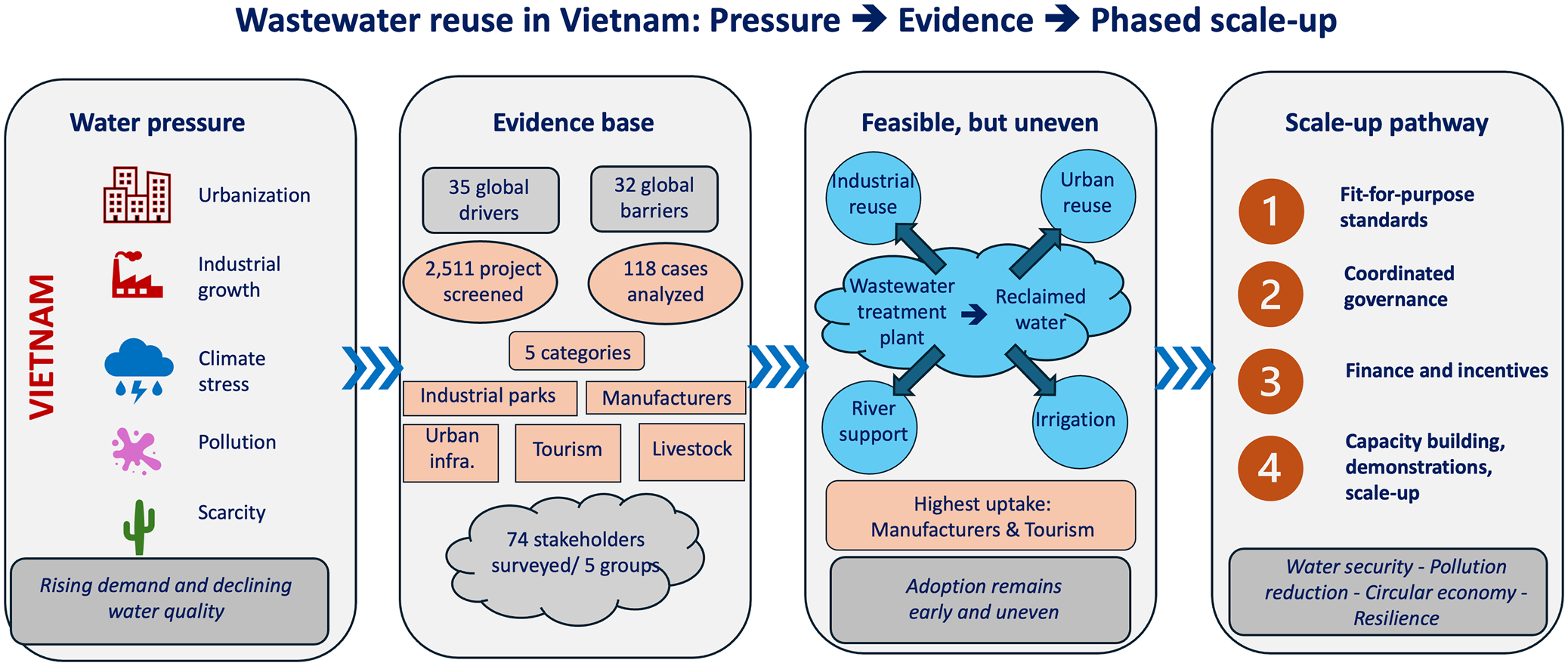
Vietnam faces growing pressure on water resources due to rapid urbanization, industrial expansion, climate change, and declining water quality. Wastewater reuse offers a promising pathway to enhance water security, reduce pollution, and advance circular-economy objectives. This study assessed wastewater reuse potential in Vietnam through a mixed qualitative approach: a systematic review of international experience, targeted review of Vietnamese policies and sectoral evidence, screening of 2,511 wastewater-generating projects reported on the national environmental consultation portal, detailed analysis of 118 selected projects, and validation through stakeholder consultation and questionnaire survey. Results show that wastewater reuse in Vietnam is driven mainly by rising water demand, environmental pressure, and regulatory interest in resource circulation, and emerging market incentives linked to green production and supply chains. However, implementation remains limited and uneven across sectors. Manufacturing and tourism projects show the strongest uptake, while industrial park infrastructure, urban systems, and livestock applications face greater institutional, technical, and economic constraints. Main barriers are the absence of fit-for-purpose reclaimed-water standards, fragmented institutional responsibilities, high treatment and monitoring costs, limited financial incentives, and low implementation confidence. Scale-up will require clearer regulation, stronger inter-agency coordination, targeted incentives, improved technical capacity, and explicit integration into long-term water and urban development strategies.